Categories
3D Scanning & Printing Digitisation

Pulling a rabbit out of a mesh hat – Liz Neely talks about 3D digitisation & 3D printing

At the tailend of February I was invited to address the National Art Educators Association at the Met. I was fresh to NYC and I was in a mood to stir. I spoke about a number of different challenges yet to be properly addressed by the sector – and the one I ended up spending most time on was the opportunities afforded by 3D digitisation and then 3D printing. What, I posed, could be made better for art education if school students could ‘print a work’ back in class? Or, coming as I do from a design museum, students could ‘re-design’ an object by pulling a 3D model apart, prototyping a new form, then printing it to ‘test it’?

Little did I know that a few months later, Don Undeen’s team at the Met itself would hold an artist-hack day to use consumer-grade tools to digitise and print certain works. Their event set off quite a wave of excitement and experimentation across the sector, and fired the imaginations of many.

Liz Neely, Director of Digital Information & Access at the Art Institute of Chicago (not), has been one of those experimenting at the coal face and I sent her a bunch of questions in response to some of her recent work.

Q – What has Art Institute of Chicago been doing in terms of 3D digitisation? Did you have something in play before the Met jumped the gun?
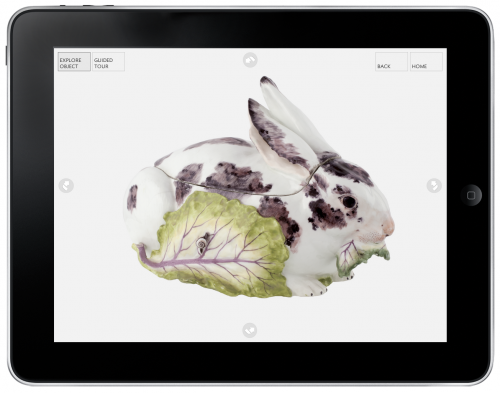
At the Art Institute before #Met3D, we had been experimenting with different image display techniques to meet the needs of our OSCI scholarly catalogues and the Gallery Connections iPad project. The first OSCI catalogues focus on the Impressionist painting collections, and therefore the image tools center on hyper-zooming to view brushstrokes, technical image layering, and vector annotations. Because the Gallery Connections iPads focus on our European Decorative Arts (EDA), a 3-dimensional collection, our approach to photography has been decidedly different and revolves around providing access to these artworks beyond what can be experienced in the gallery. To this end we captured new 360-degree photography of objects, performed image manipulations to illustrate narratives and engaged a 3D animator to bring select objects to life.

For the 3D animations on the iPads, we required an exactitude and artistry to the renders to highlight the true richness of the original artworks. Rhys Bevan meticulously modelled and ‘skinned’ the renders using the high-end 3D software, Maya. We often included the gray un-skinned wireframe models in presentations, because the animations were so true it was hard to communicate the fact that they were models. These beautiful 3D animations allow us to show the artworks in motion, such as the construction of the Model Chalice, an object meant to be deconstructed for travel in the 19th century.

These projects piqued my interest in 3D, so I signed up for a Maya class at SAIC, and, boy, it really wasn’t for me. Surprisingly, building immersive environments in the computer really bored me. Meanwhile, the emerging DIY scanning/printing/sharing community focused on a tactile outcome spoke more to me as a ‘maker’. This is closely aligned with my attraction to Arduino — a desire to bring the digital world into closer dialogue with our physical existence.

All this interest aside, I hadn’t planned anything for the Art Institute.

Mad props go out to our friends at the Met who accelerated the 3D game with the #Met3D hackathon. Tweets and blogs coming out of the hackathon-motivated action. It was time for all of us to step up and get the party started!

Despite my animated—wild jazz hands waving—enthusiasm for #Met3D, the idea still seemed too abstract to inspire a contagious reaction from my colleagues.

We needed to bring 3D printing to the Art Institute, experience it, and talk about it. My friend, artist and SAIC instructor Tom Burtonwood, had attended #Met3D and was all over the idea of getting 3D going at the Art Institute.

On July 19th, Tom and Mike Moceri arrived at the Art Institute dock in a shiny black SUV with a BATMAN license plate and a trunk packed with a couple Makerbots. Our event was different from #Met3D in that we focused on allowing staff to experience 3D scanning and printing first hand. We began the day using iPads and 123D Catch to scan artworks. In the afternoon, the two Makerbots started printing in our Ryan Education Center and Mike demonstrated modelling techniques, including some examples using a Microsoft Kinect (eg).
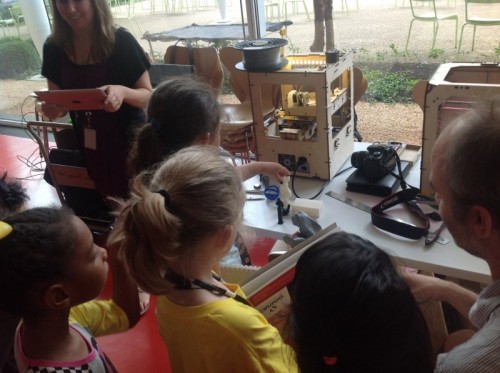
We also did the printing in a public space. Onlookers were able to catch a glimpse and drop in. This casual mixing of staff and public served to better flesh out public enthusiasm. In the afternoon, an SAIC summer camp of 7-9 year olds stopped by bringing their energetic minds. They were both completely enthralled and curiously bewildered by the process.

The event was a great success!

Colleagues began dialoging about a broad range of usages for education programs, creative re-mixing of the collection, exhibition layout planning, assisting the sight impaired and prototyping artwork installation.

Q – Your recent scan of the Rabbit Tureen used a different method. You just used existing 2D photos, right? How did that work? How many did you need? How accurate is it?
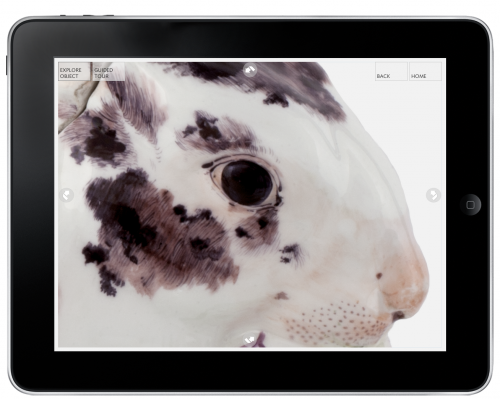
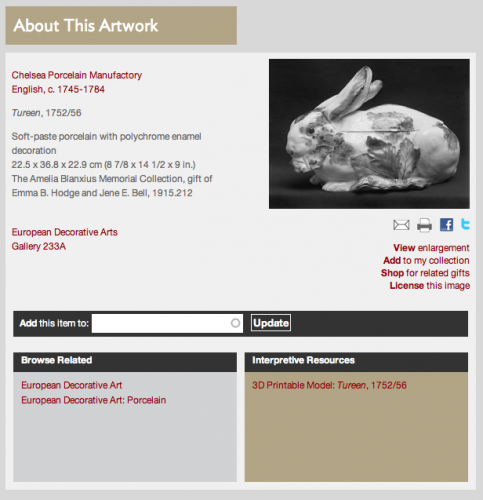
In testing image uploads onto the Gallery Connections iPad app, this particular Rabbit Tureen hypnotised me with its giant staring eye.

Many EDA objects have decoration on all sides, so we prioritised imaging much of work from 72 angles to provide the visual illusion of a 360 degree view like quickly paging through a flip book. It occurred to me that since we had 360 photography, we might be able to mold that photography into a 3D model. This idea is particularly exciting because we could be setting ourselves up to amass an archive of 3D-printable models through the museum’s normal course of 2D sculptural and decorative arts photography.

This hypothesis weighed on my thoughts such that I snuck back into the office over Labor Day weekend to grab the full set of 72 image files.

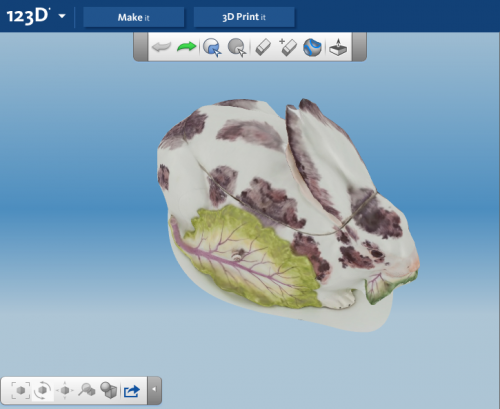
Eureka! I loaded the files into 123D Catch and it created a near perfect 3D render.
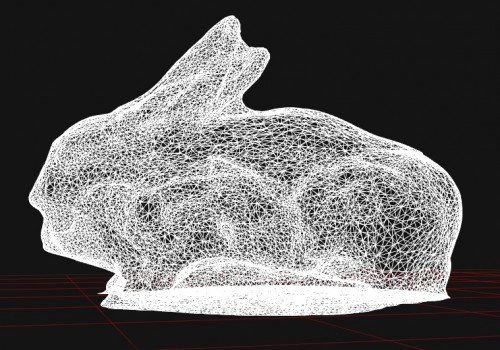
By ‘near perfect’, I mean that the model only had one small hole and didn’t have any obvious deformities. With much Twitter guidance from Tom Burtonwood, I pulled the Catch model into Meshmaker to repair the hole and fill in the base. Voila-we had a printable bunny!

The theory had been proven: with minimal effort while making our 360 images on the photography turntable, we are creating the building blocks for a 3D-printable archive!
Q – What do you think are the emerging opportunities in 3D digitisation? For education? For scholarship? Are curators able to learn new things from 3D models?

There are multitudes of opportunities for 3D scanning and printing with the most obvious being in education and collections access. To get a good 3D scan of sculpture and other objects without gaping holes, the photographer must really look at the artwork, think about the angles, consider the shadows and capture all the important details. This is just the kind of thought and ‘close looking’ we want to encourage in the museum. The printing brings in the tactile nature of production and builds a different kind of relationship between the visitor, the artwork and the derivative work. We can use these models to mash-up and re-mix the collection to creatively explore the artworks in new ways.
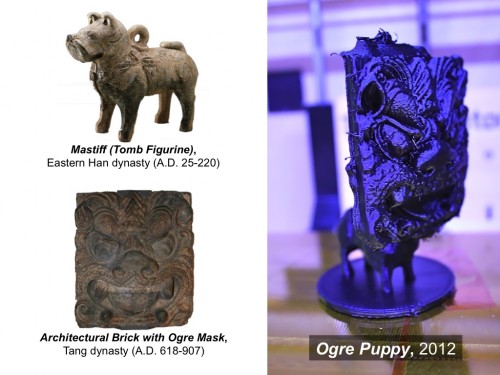
I’m particularly interested in how these techniques can provide new information to our curatorial and conservation researchers. I’ve followed with great interest the use of 3D modelling in the Conservation Imaging Project led by Dale Kronkright at the Georgia O’Keeffe museum.

Q – Is 3D the next level for the Online Scholarly Catalogues Initiative? I fancifully imagine a e-pub that prints the objects inside it!

A group of us work collaboratively with authors on each of our catalogues to determine which interactive technologies or resources are most appropriate to support the catalogue. We’re currently kicking off 360 degree imaging for our online scholarly Roman catalogue. In these scholarly catalogues, we would enforce a much higher bar of accuracy and review than the DIY rapid prototyping we’re doing in 123D Catch. It’s very possible we could provide 3D models with the catalogues, but we’ll have to address a deeper level of questions and likely engage a modelling expert as we have for the Gallery Connections iPad project.

More immediately, we can think of other access points to these printable models even if we cannot guarantee perfection. For example, I’ve started attaching ‘Thing records’ to online collection records with associated disclaimers about accuracy. We strive to develop an ecosystem of access to linked resources authored and/or indexed for each publication and audience.
Q – I’m curious to know if anyone from your retail/shop operations has participated? What do they think about this ‘object making’?

Like a traveling salesman, I pretty much show up at every meeting with 2 or 3 printed replicas and an iPad with pictures and videos of all our current projects. At one meeting where I had an impromptu show and tell of the printed Art Institute lion, staff from our marketing team prompted a discussion about the feasibility of creating take-home DIY mold-a-ramas! It was decided that for now, the elongated print time is still a barrier to satisfying a rushed crowd. But in structured programs, we can design around these constraints.

At the Art Institute, 3D scanning and printing remains, for now, a grass-roots enthusiasm of a small set of colleagues. I’m excited by how many ideas have already surfaced, but am certain that even more innovations will emerge as it becomes more mainstream at the museum.

Q – I know you’re a keen Arduino boffin too. What contraptions do you next want to make using both 3D printing and Arduino? Will we be seeing any at MCN?

Ah ha! This should be interesting since MCN will kick off with a combined 3D Printing and Arduino workshop co-led by the Met’s Don Undeen and Miriam Langer from the New Mexico Highlands University. We will surely see some wonderfully creative chaos, which will build throughout the conference.

These workshops may seem a bit abstract at first glance from the daily work we do. I encourage everyone to embrace a maker project or workshop even if you can’t specifically pinpoint its relevance to your current projects. Getting your hands dirty in a creative project can bring and innovative mindset to e-publication, digital media and other engagement projects.

Sadly I won’t have time before MCN to produce an elaborate Arduino-driven Makerbot masterpiece. I’m currently dedicating my ‘project time’ to an overly ambitious installation artwork that incorporates Kinect, Arduino, Processing, servos, lights and sounds to address issues of balance ….
Categories
API Collection databases

More on museum datasets, un-comprehensive-ness, data mining

(Another short response post)

Thus far we’ve not had much luck with museum datasets.

Sure, some of us have made our own internal lives easier by developing APIs for our collection datasets, or generated some good PR by releasing them without restrictions. In a few cases enthusiasts have made mobile apps for us, or made some quirky web mashups. These are fine and good.

But the truth is that our data sucks. And by ‘our’ I mean the whole sector.

Earlier in the year when Cooper-Hewitt released their collection data on Github under a Creative Commons Zero license, we were the first in the Smithsonian family to do so. But as PhD researcher Mia Ridge found after spending a week in our offices trying to wrangle it, the data itself was not very good.

As I said at the time of release,

Philosophically, too, the public release of collection metadata asserts, clearly, that such metadata is the raw material on which interpretation through exhibitions, catalogues, public programmes, and experiences are built. On its own, unrefined, it is of minimal ‘value’ except as a tool for discovery. It also helps remind us that collection metadata is not the collection itself.

One of the reasons for releasing the metadata was simply to get past the idea that it was somehow magically ‘valuable’ in its own right. Curators and researchers know this already – they’d never ‘just rely on metadata’, they always insist on ‘seeing the real thing’.

Last week Jasper Visser pointed to one of the recent SIGGRAPH 2012 presentations which had developed an algorithm to look at similarities in millions of Google Street View images to determine ‘what architectural elements of a city made it unique’. I and many others (see Suse Cairns) loved the idea and immediately started to think about how this might work with museum collections – surely something must be hidden amongst those enormous collections that might be revealed with mass digitisation and documentation?

I was interested a little more than most because one of our curators at Cooper-Hewitt had just blogged about a piece of balcony grille in the collection from Paris. In the blogpost the curator wrote about the grille but, as one commenter quickly pointed out, didn’t provide a photo of the piece in its original location. Funnily enough, a quick Google search for the street address in Paris from which the grille had been obtained quickly revealed not only Google Street View of the building but also a number of photos on Flickr of the building specifically discussing the same architectural features that our curator had written about. Whilst Cooper-Hewitt had the ‘object’ and the ‘metadata’, the ‘amateur web’ held all the most interesting context (and discussion).

So then I began thinking about the possibilities for matching all the architectural features from our collections to those in the Google Street View corpus . . .

But the problem with museum collections is that they aren’t comprehensive – even if their data quality was better and everything was digitised.

As far as ‘memory institutions’ go, they are certainly no match for library holdings or archival collections. Museums don’t try to be comprehensive, and at least historically they haven’t been able to even consider being so. Or, as I’ve remarked before, it is telling that the memory institution that ‘acquired’ the Twitter archive was the Library of Congress and not a social history museum.

Categories
User behaviour User experience

On ‘farewellers’ and exit marketing

So ridiculously busy right now that there is little time to blog. But stay tuned for some cool stuff over at the Labs shortly.

But here’s a the first of a few quick thoughts on some topics bouncing around the blogosphere.

This week Nina Simon wrote about her ideas of having a staff of ‘goodbyers’ instead of ‘greeters’ in order to better build continuing engagement with visitors. She writes –

We realized from this discussion that we have a huge missed opportunity when people are leaving the museum. On their way in, they are excited, curious, ready to engage. They are not ready to hear about membership or take a newsletter about what’s coming up next time. They bolt right past those tables to the “good stuff.” But at the end, they’ve had a great time, and they want a takeaway from the experience. They WANT to join the email list. If we’re smart, we should be developing a takeaway that both memorializes the visit and leads them to another. In other words, we should be giving them a string for their new pearl.

This reminded me a lot of the efforts we’d go to back in the early 90s putting on all night parties. Before this was a task given to ‘street teams’ (no one had commercialised enough to hire people to do the least exciting tasks), you’d take a stack of flyers to parties at the very end of the night just as the dawn anthems were blasting through the bassbins and start giving them out as people exited. Others would go and plaster the windscreens of parked cars to similar effect. No one would ever give out flyers early on in the party – they’d get forgotten, sweaty, destroyed, or just ‘repurposed’. It was all about ‘exit marketing’ – and it was an important part of building bonds within the subculture. Flyers for the next month’s worth of warehouse parties made for a strong encouragement to ‘stay involved’ – especially as most people would be returning to their ‘ordinary lives’ during the week, saving their living for the weekends. It gave newcomers a sense that this wasn’t just a fleeting ‘temporary autonomous zone‘ but something they could regularly return to, and for the hardcore flyers and their effective distribution became core ‘subcultural media’. I’d argue that they were more effective than the more scattergun street press advertising, and definitely more successful than ‘record shop drops’.

Now museums rarely ignite the sort of passion that subcultures do. Perhaps they should, but that’s unlikely to happen given the age demographics. But there’s plenty to be had in Nina’s idea – the farewelling experience is likely to be the only opportunity to remind visitors that museum visits need not be a ‘one-off occurrence’ or a ‘once a year’ activity, but an essential part of their cultural calendars.

And of course, ‘farewelling’ behaviours are exactly the sort of things that you’d be hoping the staff in your ‘well placed gift shop‘ are doing as just good business.

Categories
Conceptual

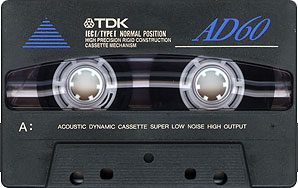
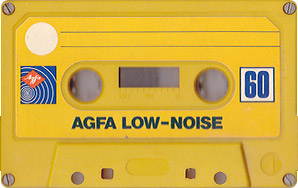
An exhibition is a mixtape

The best mixtape is made with love and care.
The best mixtape requires deep knowledge and skill to make.
The messages contained in a mixtape are simultaneously opaque and clear.
A mixtape is an invitation.
A mixtape is not a compilation.

I’ve been thinking a lot about exhibitions recently. They are expensive beasts and tend to still be produced with the same models of high risk cultural production as cinema.

As the museum educator has risen in prominence and institutional power over the last three decades, exhibitions have been challenged by the ‘event-driven museum’. So much that exhibitions, themselves, have become ‘events’ – in the most contentious and problematic form of ‘blockbusters’.

At the same time we’ve seen the spread of the verb ‘curate’, and the noun ‘curator’. Some people even want appropriate credit for their online ‘curatorial’ skills.

Researching and then assembling a narrative told by music selections to communicate messages of love, hate, ambivalence, or just to assert your superior (sub)cultural capital – that’s what making a mixtape was all about. Exhibitions, in their most primal form, are not that different.

The mixtape is dead.
The mixtape died with MP3.
The mixtape died with iTunes.
The mixtape died when it became an ‘unconstrained’ playlist.

So where is the new model for exhibitions in a world where mixtapes have been replaced by iTunes and now Spotify?

Categories
Exhibition technology

On robot guides

The robot guides are coming.

This isn’t entirely new – as some Japanese museums have been, unsurprisingly, experimenting with this for over a decade. One of my fondest science museum memories was stumbling upon a ‘bipedal robotics conference’ inside the Miraikan in Tokyo sometime in the early 2000s.

But this is slightly different and combines the potential of the ‘Roomba-Curator’ (hat tip to Aaron Straup-Cope for that phrase) with the growing trend for ‘school incursions‘ (rather than ‘school excursions’) but delivered over high speed broadband.

The robot is in preliminary design but expected to be the height of an average adult, have a motorised base with wheels and a “head” that is a 360-degree, panoramic camera.

It will find its way around the museum and avoid bumping into visitors and objects using sensors and a sort of global positioning system.
The robot is initially for the use of school students, who will each control the robot’s camera head using computers as if in a video conference.

The camera can transmit many views of an object simultaneously – from above or the sides and zooming in and out – so each user can control what they see.

I like that this lets multiple students control their view and zoom on objects of their own choosing.

But I’d really like this if it was deployed to the collection stores – the behind the scenes areas where museums keep all vast numbers of the objects they don’t have on exhibition.

Imagine an informational overlay using a collection API to pull up data on shelves and shelves of objects.

It won’t be far off.

Categories
Conceptual User experience

On Sleep No More, magic and immersive storytelling

If you’ve run into me in New York City since I moved here six months ago I’ve probably badgered you about Sleep No More.

It was something I saw in my first weeks after moving here after two aborted attempts on previous trips to New York. Best described as an immersive theatrical experience, it has deeply affected the way I think about theatre, theme parks, exhibitions and museum experiences in general. And, coupled with my experiences at the Museum of Old & New Art before I left Australia, it has challenged my thinking around ‘participation’ and ‘openness’.

Loosely based on Macbeth, inspired by film noir, and transforming 100,000 square feet of a 5 storey warehouse in Chelsea, Sleep No More is about immersive exploration rather than a linear narrative. Everything is touchable, openable, operable. It is a world of cinematic detail – shelves, drawers and cabinets are full of papers and objects that are purposefully selected and layered with information from and about the story world – and sound and smell are turned up to 11. With the audience masked, silent, and anonymised, the experience becomes highly individualised and for three hours you explore, following performers if they take your fancy, or chancing upon happenings and scenes.

Apart from the choreography of the performers themselves, there is a sense of the audience being choreographed as they spread out and move loosely through the space, yet always managed to be ‘nudged’ subtly to climactic moments in the larger congregational spaces. Friends have remarked how game-like it is in the way it does this nudging – and on my first viewing I made connections to the ways in which good 3D sandbox games manage to maintain a core narrative whilst encouraging players to ‘freely explore’.

Despite this subtle nudging your experience will be different to mine. Couples are advised to purposefully split up for the duration of the adventure to have a more individualised experience (and a lot more to talk about afterwards).

If you haven’t been and you are visiting New York in the next little while, then I do urge you to go. And try not to read to much about it beforehand.

So tonight at Storycode – a periodic transmedia & storytelling meetup – I was excited to hear Pete Higgin and Colin Nightingale from Punchdrunk talk about the development of Sleep No More in its current incarnation and their approach to storytelling. (You can watch the video of the whole talk on Livestream).

Punchdrunk have been working with MIT Media Lab to explore ways in which a complementary experience of the environment could work online. Last week, in some trials, several audience members were selected to wear special masks with sensors and cameras and joined their fellow patrons in the regular Sleep No More performance. Connected to them were selected online participants who experienced a version of the performance through an interface that recalled the classic text adventure, but with ambient sound and some intermittent vision.

The selected audience members were drawn to specific parts of the set where a communications portal between the online and onsite opened so that they could communicate with each other – mediated by actors in a control room. This is going on in realtime in the same physical environment as the regular performance – so it is a strange kind of ‘third story’ in the same world. These ‘portals’ were subtly disguised in the fabric of the set so as to be unnoticeable by others.

Obviously there were some issues – the additional layers of the 3rd story secret world were not obvious – but that’s not necessarily a bad thing. And the locational technology (Bluetooth) and content delivery/transmission over wifi didn;t always work satisfactorily. There’s a New York Times piece on the experiment from the point of view of an participant that is worth a read.

What really impressed me was the deep consideration that had gone into making the online experience for the remote participant as immersive as possible by using sound and the limitations of text descriptors rather than relying on inadequate video or worse, the uncanny valley of 3D simulations.

The online experience wasn’t meant to be a ‘replica’ of the Sleep No More experience, but a parallel to it.

This parallelism is something I’d love to see museums do more with. Online/digital as a parallel experience. This is what so much discussion in the museum (Rodley) blogosphere (Cairns) has recently been about.

Take a look at Punchdrunk’s recent outreach and literacy program ‘Under The Eiderdown’.

Hit play. Watch the seven minutes. Then come back. It is worth it.

Wow.

Towards the close of their talk Pete Higgin had a nice line – “explanation is the killer of wonderment”.

It reminded me of a recent article from Salon on the effect of YouTube on the traditions and social practices of magicians.

“The biggest problem with DVD and YouTube exposure is that it has damaged the skill of learning through asking, and it has created the mistaken assumption, perhaps, that all knowledge and all wisdom is available to buy,” [magician Jamy Ian Swiss] said. “And there’s so much difference between those two acts, because asking involves a human experience, while buying is just sitting in your couch and passively absorbing countless secrets that you think constitute magic.”

Magic, like theatre, isn’t about the technicalities of the tricks – it is about performance and the moment.

Higgin told an anecdote about a run-in with a overzealous ‘fan’ who had created an article deconstructing the timings of scenes in Sleep No More – under the strange assumption that by giving the ‘factual information’ would actually be useful. It is a tension that plays out in all media now – the plot summaries and spoilers that are immediately posted to Wikipedia for popular TV series after an episode airs – but for immersive, purposefully opaque narrative experiences the stakes might just be higher.

Museums, especially those of the scientific and historical persuasion, have been hesitant to embrace theatricality – “there be charlatans”, or worse “there be theme parks” – yet all good storytelling is all about performance. (Something public librarians at Reading Time know all too well).

Yet consider the mass popularity of the early commercial museums in the late 19th century when scientific phenomena were akin to magic and Coney Island had premature babies in cribs showing the ‘miracles of modern medicine’ and freak shows, and electricity! Wonderment!

These are not things we generally think of as desirable in a modern museum – however there may still be much to learn about their appeal that still applies today.

—

What if we designed exhibitions to have the same ‘dense, cinematic detail’ that Punch Drunk’s productions have? (And trusted visitors to respect and engage with them appropriately through scaffolding the entry experience?)

What if we designed our exhibitions to hold things back from some visitors? And to purposefully make some elements of an exhibition ‘in-accessible’ to all? (The Studio Ghibli Museum in Tokyo is wonderfully designed with some spaces and passages that are only accessible by small children that lead to experiences that only children can have separate from their parents.)

What if we made ‘wonderment’ our Key Performance Indicator?

Categories
Conceptual

Museums and making the ‘digital shift’

I’m mid-way through writing a number of articles that explore the challenges for museums in pulling ‘digital’ into their core operations. As a result I’ve started to formulate this idea –

museums will not be able to properly understand and integrate ‘digital’ into their organisational DNA until they have substantial born-digital collections.

Libraries have had a significant head start, I’m beginning to think, because of their ever increasing digital holdings. Not to mention the acceleration of their shift to being ‘service-oriented’ which had its seeds in the 1980s.

Discuss.

(Regular readers will know that I’ve discussed digital experiences, augmenting physical objects, visitor engagement etc, as well as the organisational change aspects at length before. This idea is additive to those pre-existing conversations. If you are new to this then have a read of my summative post from Web Directions a few months ago).

Categories
Conceptual Interactive Media

The museum as a text adventure – Inform7 and TourML/TAP

Today I was sitting at WebWise 2012 listening to Rob Stein talk about TAP/TourML and he started talking about games and stories referencing Marc Reidl’s work.

It reminded me a lot of the world of interactive fiction and it got me thinking about whether it would be possible to use TourML to generate text adventures.

And then, whether long established interactive fiction authoring tools like Inform7 (used as the system behind PlayFic) could be used to author gallery tours.

Being of a generation that has fond memories of playing Infocom adventures (I vividly remember my dad buying Zork II for our Commodore 64) – there’s definitely a lot to learn about how this narrative genre works that could equally be applied to the creation and support of visitor narratives.

So I took 20 minutes to whip up a very very basic ‘playable’ text advennture rendering of the conference experience.

Go play it on PlayFic! (It obviously isn’t finished)

Here’s the source code. (contains spoilers!)

[code]The story headline is “Adventures at WebWise”.

The story description is “A quick journey into interactive fiction inspired by Rob Stein’s introduction to TAP presentation and his referencing of Marc Reidl. It raised, in my mind, that there are already robust frameworks for quickly generating interactive fiction of the sort that makes the foundation of a mobile tour – so, could TAP use the Inform7 language for advanced authoring?”

The Main Conference Room is a room. “Rows of tables, each with their own powerstrip stretch endlessly toward the speaker podium. Two projection screens show the wifi login details whilst unfashionably out of date pop music plays softly over the speaker system.

On the table nearest you is a conference pack and an abandoned Samsung Galaxy.

The foyer is to the South.”

Projection screens are scenery in the Main Conference Room. Speaker system is scenery in the Main Conference Room.

Samsing Galaxy is a thing. The Samsung Galaxy is in the Main Conference Room. The description is “The Samsung Galaxy is turned off. You cannot figure out how to turn it on, and, turning it over, you realise that the battery has been removed. Helpful isn’t it?”

Conference Pack is a thing. Conference pack is in the Main Conference Room. The description is “The conference pack, like all conference packs, is looking for the recycling bin. You notice that the conference schedule has already been removed, leaving only the wad of promotional materials.”

South of the Main Conference Room is the Foyer.

The Foyer is a room.”The foyer is empty.

Lukewarm coffee drips from a boiler but there are no cups nearby. The crumbs of food that used to be here litter the floor. Obviously these places don’t pay their venue staff very well. A faint waft of perfume comes from the East.”

East of the Foyer is the Lifts.

Lifts is a room. “As you enter the lift lobby you notice the furthest-most door has just closed.

The whirring of motors comes from behind closed lift doors.

Strangely, there are no lift buttons and the concierge must have gone on a break.”[/code]

That doesn’t look like source code does it?

Doesn’t it look exactly like the sort of language that museum educators and curators coud quickly learn and write?

Categories
Collection databases Conceptual

Metadata as ‘cultural source code’

A quick thought.

Last week I wrote about collection data being ‘cultural source code’ in the context of the upload of the Cooper-Hewitt collection to GitHub.

As I wrote over there,

Philosophically, too, the public release of collection metadata asserts, clearly, that such metadata is the raw material on which interpretation through exhibitions, catalogues, public programmes, and experiences are built. On its own, unrefined, it is of minimal ‘value’ except as a tool for discovery. It also helps remind us that collection metadata is not the collection itself.

If you look at the software development world, you’ll see plenty of examples of tools for ‘collaborative coding’ and some very robust platforms for supporting communities of practice like Stack Overflow.

Yet where are their equivalents in collection management? Or in our exhibition and publishing management systems?

(I’ll be cross-posting a few ideas over the next little while as I try to figure out ‘what goes where’. But if you haven’t already signed up to the Cooper-Hewitt Labs blog, here’s another reminder to do so).

Categories
General

Three months in. Be a summer intern!

Three months in now.

And if you’ve been keeping an eye on the Cooper-Hewitt Labs blog you’ll know that email marketing and event ticketing has been overhauled, we’ve optimised our hosting platforms, a new monthly newsletter has been started, and last week we released our collection dataset to the public domain on Github under a Creative Commons Zero dedication.

My team has also been busying with webcast events and getting the volume of posts on the Design Blog increased, as well as experimenting with different social media tactics elsewhere. Behind the scenes, there’s plenty of long term planning going on with the Mansion rebuild under way, and embedding digital infrastructure into it.

There’s a fair bit more on the near horizon – an entirely new ecommerce presence for the Cooper-Hewitt Shop, a CMS migration – and quite a bit more.

But, for readers of Fresh & New(er) who happen to be students, you might be interested know that we’re taking on summer interns!

The deadline for applications is March 1 so hurry!